Combined Algae Test with Unicellular Green Algae
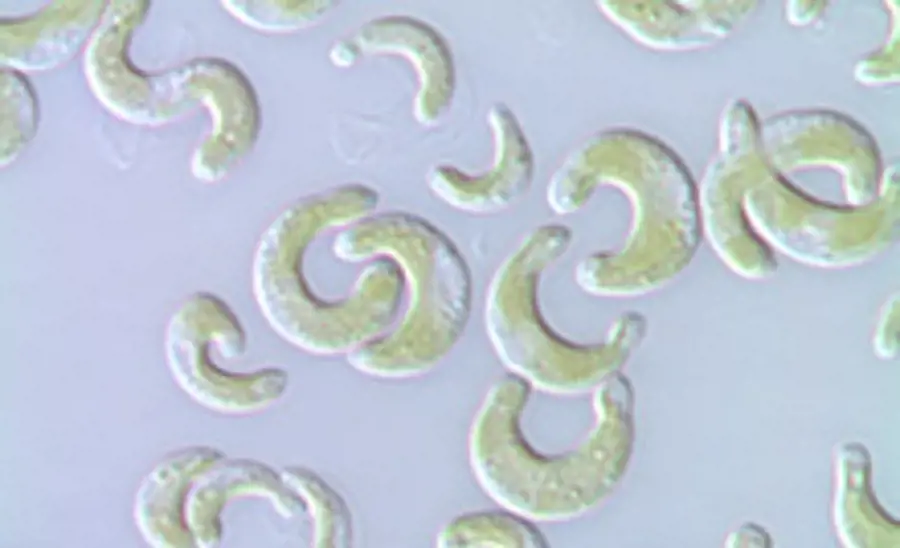
Test organism
Unicellular freshwater green algae (Raphidocelis subcapitata)
Detectable effects (impact)
Inhibition of photosynthesis (herbicidal effect)
Inhibition of growth
Test principle
In this test, the herbicide-induced, specific effects of chemicals or environmental samples on the photosynthesis of algae after 2 h and 24 h exposure time are recorded and the unspecific effects on the growth of the algae after 24 h exposure time are measured.
The test combines the assessment of photosynthesis and growth inhibition.
Growth inhibition stands for unspecific toxicity and is determined by means of the cell density through absorption at 685 nm.
Photosynthesis inhibition is based on the inhibition of Photosystem II (PSII) and indicates herbicide-specific toxicity.
Test procedure
SOP available on request from Andrea Schifferli
Video tutorial
Test duration
24 h
Relevance
Substitute organism for primary producers
Standard test organism for water quality evaluation (OECD, US EPA, ISO)
Guidelines and literature
Escher BI, Bramaz N, Mueller JF, Quayle P, Rutishauser S (2008). Toxic equivalent concentrations (TEQs) for baseline toxicity and specific modes of action as a tool to improve evaluation of ecotoxicity tests on environmental samples J. Environ. Monit. 10, 612-621.
Escher BI, Rutishauser S (2007). The combined algae test- a new routine 96-well-plate biotest for simultaneously assessing the photosynthesis inhibition and effect on growth in green algae. Internal Report, Eawag, Dübendorf, Switzerland
International Organization for Standardization (2004). Water quality -- Freshwater algal growth inhibition test with unicellular green algae. ISO 8692: 15 p.
Schreiber U, Quayle P, Schmidt S, Escher BI, Mueller J (2007). Methodology and evaluation of a highly sensitive algae toxicity test based on multiwell chlorophyll fluorescence imaging. Biosens. Bioelectron. 22, 2554-2563.