22. May 2026, Topic: Aquatic Ecotoxicology
Roads as a source of pollution: new challenges
When it comes to the release of hazardous substances from roads into the environment, the focus is increasingly shifting from traditional pollutants and particles to novel, and in some cases unknown, substances. The Ecotox Centre is investigating the ecotoxicological effects of road runoff and tire wear and is attempting to identify the most critical substances.
Roads play a vital role in our mobility and are an integral part of everyday life. Yet at the same time, they are a significant source of chemical contamination in water bodies and soil. What began as early as the 1960s with the first water protection guidelines for road construction has now become a complex challenge: whilst conventional pollutants such as polycyclic aromatic hydrocarbons (PAHs) and heavy metals from asphalt and petrol were initially a cause for concern, tire wear was later added to the list. This represents a major source of microplastics entering the environment, but also contains numerous chemicals. Several current projects at the Ecotox Centre demonstrate just how diverse the impacts of road traffic are – and how important it is to investigate them in a nuanced manner.
Tire wear: Harmful additives and transformation products
A milestone in the international debate on road pollutants came in 2021 when scientists discovered that the substance 6PPD-quinone, formed from tire wear, was the cause of the mass die-off of coho salmon in North America. The substance is produced from the tire additive 6PPD, which is used as an antioxidant in rubber compounds. Although the coho salmon affected are not found in Europe, the finding highlighted just how little we still know about the transformation products and environmental impacts of tire chemicals. Tire wear is one of the most significant sources of transport emissions – and has potentially far-reaching ecological consequences.
Pilot study on the impact of road runoff
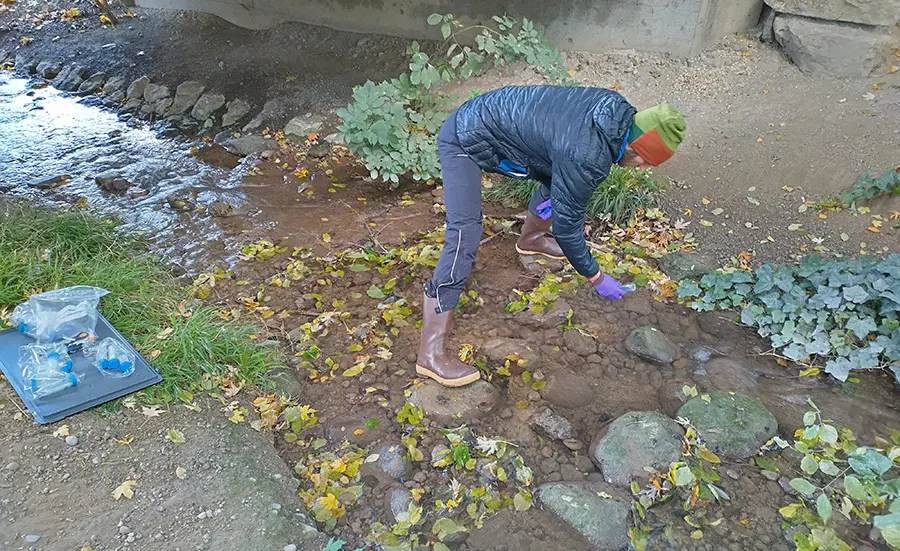
In a pilot study conducted in the city of Zurich in collaboration with Entsorgung und Recycling Zürich, the Ecotox Centre investigated the impact of road runoff on urban water bodies. The researchers examined two local streams in Schwamendingen with different infrastructure: the Schwamendinger Dorfbach is largely open and receives only a small amount of direct road runoff, whilst the Spitalerbach is mostly culverted and derives a significant proportion of its water from road runoff. Both streams flow into the Glatt.
The researchers took water samples from both streams and analysed them for the presence of three substances: 6PPD-quinone, 1,3-diphenylguanidine (DPG), a vulcanisation accelerator, and hexamethoxymethylmelamine (HMMM), an adhesion promoter between tire layers. “These substances act as markers for the input of road runoff,” explains project leader Alan Bergmann. “Together, they provide us with a characteristic signature for traffic-related road runoff and allow us to better assess the influence of tire abrasion in complex environmental samples.”
Increased input of road runoff following rainfall
Two sampling campaigns in November 2024 and May 2025 painted a consistent picture: significantly higher concentrations of the three markers were measured in the Spitalerbach than in the Schwamendinger Dorfbach . The levels rose sharply, particularly following rainfall, which underscores the close link between rain, road runoff and chemical pollution. In addition to tire chemicals, the researchers also found the façade biocide diuron, in some cases at concentrations exceeding chronic environmental quality criteria. The chemical analyses thus showed not only that the Spitalerbach is more heavily polluted by road runoff, but also that urban watercourses are exposed to many different sources of pollutants.
Effect-based analyses help to identify hazardous substances
To investigate the ecotoxicological effects of the water samples, additional bioassays were used, coupled with high-performance thin-layer chromatography. The samples were thus tested for bacterial toxicity, estrogenic effects and the activation of the aryl hydrocarbon receptor, which indicates the presence of PAH-like chemicals. “These methods reveal the presence of biologically active substances, even if we do not know their structure,” explains Alan Bergmann. “This allows us to detect unknown toxic substances and begin to identify them.”
Here, too, it was found that the Spitalerbach stream exhibited the highest level of bioactivity – consistent with the higher concentrations of markers for road runoff. At the same time, however, bioactive substances were also detected in less contaminated samples. “This suggests that, in addition to tire abrasion, other, as yet unknown substances contribute to the toxic effect,” says Bergmann. Some of the bioactivity patterns observed matched those of extracts from tire material, indicating the involvement of tire chemicals.
“The Zurich case study exemplifies just how strongly road runoff influences urban water bodies,” says Alan Bergmann. “Depending on the exact discharge conditions of the road runoff, there are significant differences between individual water bodies.” Whether and to what extent this creates risks in receiving water bodies such as the Glatt depends on dilution, additional sources and the biological sensitivity of the organisms living there. Many of the substances detected are also new or insufficiently characterised, meaning that the basis for an assessment is lacking.
Major project on the ecotoxicity of tire abrasion
These findings form part of a long-term project on the ecotoxicity of tire wear, which the Ecotox Centre is carrying out in collaboration with Eawag and EPFL on behalf of the tire industry. The aim of the project is to gain a better understanding of the bioavailability and toxicity of pollutants in tire wear particles, as well as the direct effects of these particles on organisms. Tire particles contain substances that have potentially estrogenic, genotoxic and bactericidal effects and can be released into the environment. Experiments with gill and intestinal cells from rainbow trout suggest that the concentrations of tire wear found in the environment are not acutely toxic to fish. However, other experiments have shown that earthworms avoid soil that is more heavily contaminated with tire particles.
Focus on street cleaning
Several other projects carried out in collaboration with cantons have focused on the cleaning of road surfaces. In Switzerland, low-noise asphalt is increasingly being used for such surfaces, as its porous structure helps to reduce traffic noise. However, the voids become clogged over time, causing the asphalt to lose its acoustic properties. To restore its acoustic functionality, the roads are often cleaned using high-pressure water jets. In the canton of Geneva, the Ecotox Centre has tested the effectiveness of various cleaning methods for low-noise asphalt. “We have seen that high-pressure methods and simulated rainfall events can both lead to the mobilisation of pollutants,” says project manager Etienne Vermeirssen. “This was directly evident in the results of the bioassays we conducted to characterise the toxic effects.”
In future, the Ecotox Centre aims to investigate how the release of pollutants during road cleaning can be reduced through innovative cleaning technologies and operational strategies. These findings are relevant not only to water quality but also to assessing how sustainable and maintenance-intensive certain road surfaces are. In addition, the toxicity of road runoff in road runoff treatment plants will be examined in greater detail.
Roads are thus increasingly becoming a focal point in the debate on water protection. “The combination of chemical analysis and effect-based tests enables us to consider known and unknown pollutants together and set priorities for further investigations,” says Vermeirssen. The Ecotox Centre aims to systematically close current knowledge gaps and create a robust basis for authorities, policymakers and practitioners – so that mobility and water protection remain compatible in the future.
Project report
Bergmann, A.J., Vermeirssen, E.L.M. (2025) Bioactive chemicals in Zurich streams in context of road runoff and tire wear particles
 E-mail
 Facebook
 Twitter
Contact

 Subscribe to our News by RSS feed