08. January 2026, Topic: Aquatic Ecotoxicology Risk Assessment Soil Ecotoxicology Sediment Ecotoxicology
Safer receipts without bisphenols
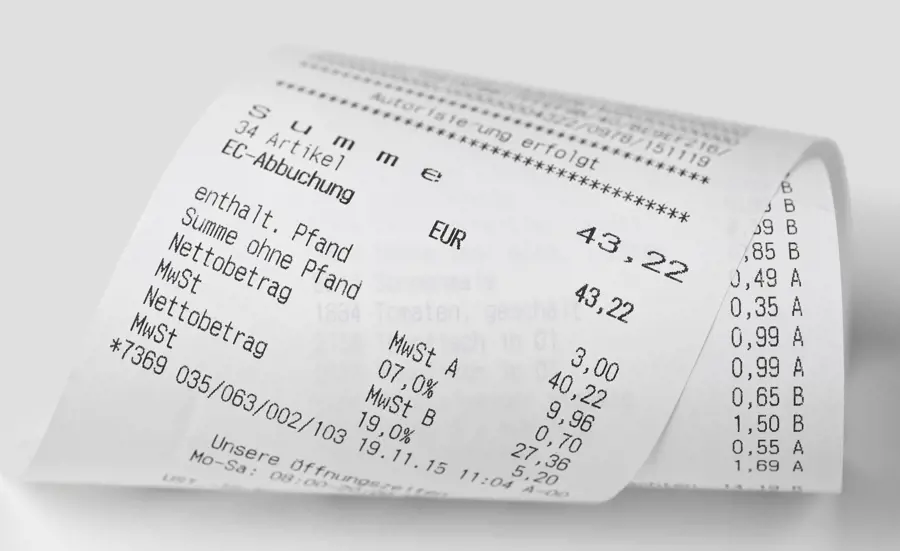
Researchers at EPFL have developed a new formula for thermal paper that is free of harmful bisphenols. According to toxicological studies conducted by the Ecotox Center, the wood-based substitutes used are significantly less problematic than traditional substances.
Millions of people use thermal paper every day – in the form of receipts, shipping labels, tickets or medical records – without thinking about it. The underlying technology is based on heat-sensitive coatings: heat causes a colourless dye to react with a developer, producing dark text in the heated areas.
Thermal paper may be small, but it has a large environmental footprint. It is produced in large quantities, used daily and often recycled, which means that the chemicals it contains can end up in water and soil. For decades, bisphenol A (BPA) and – as a supposed alternative – bisphenol S (BPS) have been among the most commonly used developers. Both substances can disrupt hormonal processes in living organisms and have been detected in both the environment and the human body, especially in people who come into frequent contact with receipts.
Difficult search for alternatives
The search for safe alternatives is proving difficult. Thermal paper must not only be harmless to health, but also stable, easy to print on and inexpensive. The global market for thermal paper was estimated at around four billion US dollars in 2022 and is expected to grow to around six billion US dollars by 2030. Although regulatory authorities and manufacturers have been searching for substitutes for years, many potential alternatives fail to meet the high technical requirements: they must react at the right temperature, remain stable during storage, mix well with other coating components and not cause background discolouration. Bio-based materials in particular have rarely been able to fully meet these criteria to date.
A research team from EPFL and the Ecotox Centre has now shown that materials derived from wood can meet these requirements. In a study published in Science Advances, the researchers describe thermopaper coatings based on lignin – a major component of wood – in combination with a sensitiser made from plant sugar.
Natural substances are significantly less toxic
When heated, the lignin-based coatings produced clear print images with colour densities comparable to those of commercially available thermal paper. They also proved to be stable in storage: even after months of storage near a window, the paper remained unchanged and printed logos were still clearly legible after a year. Although the image contrast was slightly lower than that of fully optimised commercial thermal paper, the overall performance was comparable to that of products containing BPA.
Biotests conducted by the Ecotox Centre showed that the lignin-based developers were two to four orders of magnitude less estrogenic than BPA. The sugar-based sensitiser was neither estrogenic nor toxic. The study shows that safer thermal paper formulations can be made directly from non-edible biomass using simple processing steps. Although further work is needed to optimise print quality and scale up production, the results suggest that receipts and labels can fulfil their purpose without relying on problematic chemicals.
Publication
Tom Nelis, Manon Rolland, Claire L. Bourmaud, Etiënne L.M. Vermeirssen, Ghezae Tekleab, Harm-Anton Klok, Jeremy S. Luterbacher. Sustainable Thermal Paper Formulation Using Lignocellulosic Biomass Fractions. Science Advances 2 January 2026. DOI: 10.1126/sciadv.adw9912
Text: Nik Papageorgiou (EPFL), adapted
 E-mail
 Facebook
 Twitter
Contact

 Subscribe to our News by RSS feed