Yeast Estrogen and Androgen Screens
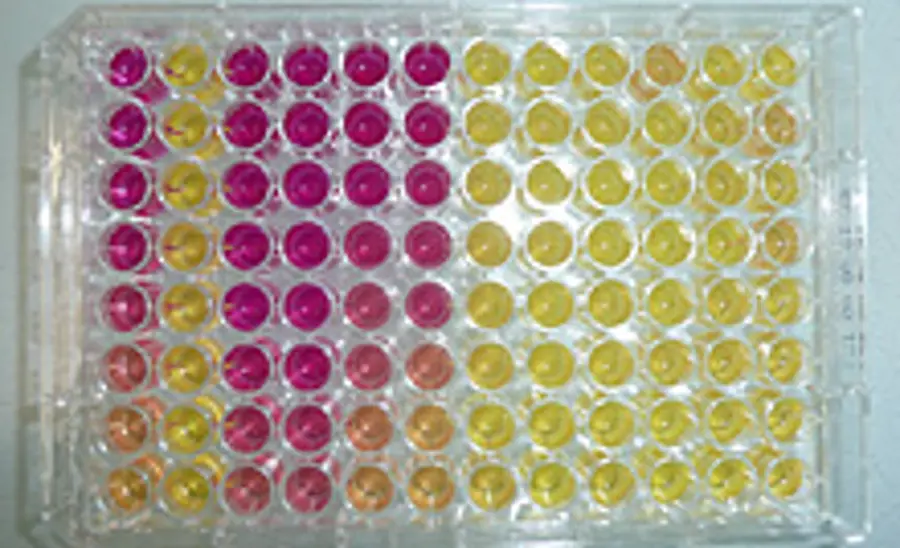
Test organism
Baker’s yeast (Saccharomyces cerevisiae)
Detectable effects (impact)
Activation or inhibition of the human estrogen receptor (YES, (anti-)estrogenic effect)
Activation or inhibition of the human androgen receptor (YAS, (anti-)androgenic effect)
Test principle, taking YES as an example
In the Yeast Estrogen Screen, genetically modified yeast cells (Saccharomyces cerevisiae), which contain the gene for the human estrogen receptor coupled with a so-called reporter gene (LacZ), indicate estrogenic effects.
If an estrogenically active substance binds to the estrogen receptor in the cell, the corresponding gene and then the reporter gene are read. The latter gene encodes for an enzyme (beta-galactosidase), which converts a dye (yellow to red) and thus induces a colour reaction, which is directly correlated to the existence of estrogenically active substances.
After 18-hour exposure to chemicals or environmental samples, the estrogeneity of the analysed samples can be measured based on colour induction.
By means of lyticase digestion of the yeast cells (L-YES) after exposure, the sensitivity can be increased by about one order of magnitude.
The same assay principle applies to the detection of anti-estrogenic substances in YES, as well as androgenic and anti-androgenic substances in YAS.
Flow Chart
Video tutorial
Test duration
3 days (exposure time: 18 hours)
Relevance
Suitable for detecting numerous natural and synthetic hormonally active substances such as environmental toxins from everyday products, e.g. birth control pill ingredients (17α-ethinylestradiol), synthetic materials (bisphenol A, phthalates), pesticides (methoxychlorine) and non-ionic surfactants (alkylphenoles).
Substances with an activating or inhibitory effect on the estrogen and/or androgen receptor of organisms may interfere with reproduction, affect the metabolism and immune system and induce the formation of tumours.
Guidelines and literature
ISO 19040-1:2018 Water quality — Determination of the estrogenic potential of water and waste water — Part 1: Yeast estrogen screen (Saccharomyces cerevisiae)
Routledge EJ and Sumpter JP (1996). Estrogenic activity of surfactants and some of their degradation products assessed using a recombinant yeast screen. Environ. Toxicol. Chem. 15(3): 241-248.