17. November 2026, Topic: Soil Ecotoxicology
Key reference ranges for bioindicators
Researchers at the Ecotox Centre have determined the natural variability for four species of soil organisms that serve as ecotoxicological bioindicators for assessing soil health. In doing so, they are laying the foundations for the applied use of these methods and a more meaningful soil monitoring.
The health of our soils is essential and the soil organisms living within them also influence soil fertility and thus food production. To reduce the risks posed by plant protection products (PPPs) and to preserve soil fertility, the Swiss Confederation launched the Plant Protection Products Action Plan in 2017. As part of this action plan, the Ecotox Centre, together with several project partners, is developing a concept for monitoring PPP residues in agricultural soils.
Bioindicators for soil monitoring
But how can we determine the extent to which soil is contaminated? "Whilst chemical analyses do detect PPP residues, they do not indicate whether the substances are bioavailable or whether they have an effect on soil organisms," explains project leader Mathieu Renaud. "This is where soil organisms can help, by indicating contamination levels through their effect on biological processes such as reproduction or growth – these are also referred to as bioindicators." The Ecotox Centre has proposed several bioindicators for assessing soil fertility. These include, for example, enchytraeids and springtails.
What has been lacking so far, however, is a suitable method for interpreting the monitoring results and identifying deviations from the normal state. A key challenge here is the natural diversity of soils, as properties such as pH, organic matter or texture can influence how test organisms develop in the soil.
Determination of natural reference ranges
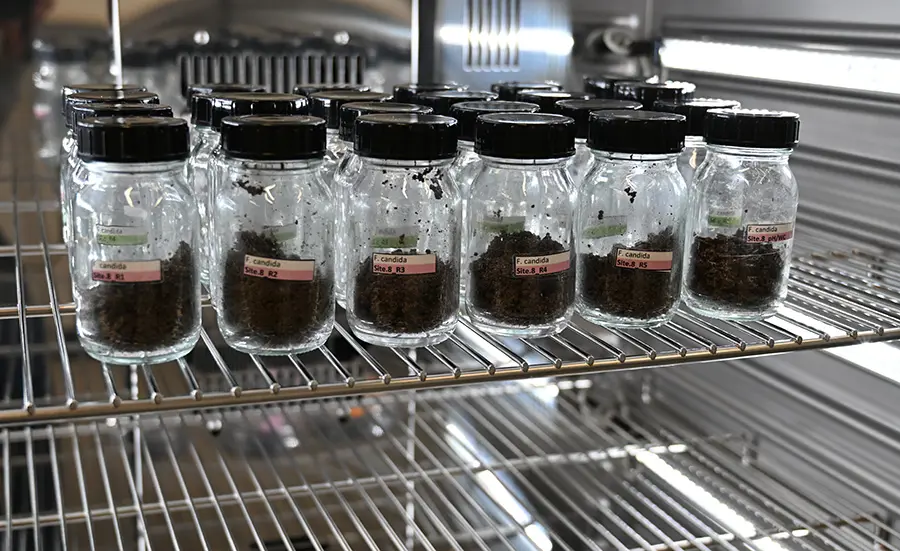
To be able to classify a biological response, a suitable reference is therefore required. In ecotoxicological laboratory tests, a standardised soil is often used as a control. "However, such a control soil is not necessarily representative of the soils being investigated in the monitoring programme," says Renaud. "This can lead to biological responses being misinterpreted, with differences from the control arising not from contamination but from the natural variability in the different soils." Mathieu Renaud and his fellow researchers therefore selected 32 soil samples from the Swiss Jura and assessed the responses of four test organisms in these samples: specifically, the reproduction of springtails and enchytraeids, and the root and shoot lengths of oilseed rape and onion.
The researchers compared two different approaches to determining the expected range of responses – that is, the natural variability across the different soils. In the first approach, the responses in the soils were compared with a standardised control soil and the deviations were assessed. The second approach was based directly on the normal distribution of the measured values within the soils. "We were able to determine normal ranges for all four test species," says Renaud. "The distribution-based approach was more suitable for determining these normal ranges than the comparison with the control soil." The soils examined contained only very low levels of pesticide residues. They were therefore suitable for reflecting natural biological variability.
Verification using contaminated soils
The results show that reference ranges can be derived directly from the natural variability of bioindicators in soils within a region. Such ranges can help to distinguish between natural fluctuations and responses to plant protection products. At the same time, it became clear that the variability differed between the individual test species and that there is no universal reference range for all soils and organisms. Such reference ranges must therefore be defined on a species-specific basis and, where possible, regionally.
“Next, we will extend our approach to other soil types and regions in Switzerland and compare the normal ranges determined in this way with contaminated soils,” says Renaud. “This will enable us to assess how sensitive and reliable the bioindicators are at detecting contaminated soils under real-world monitoring conditions.”
Publication
Junghans, M., Balk, F., Campiche, S., Lauber, E., Renaud, M., & Ferrari, B. J. D. (2026). Soil Guideline Values - proposed screening values for the integrated assessment of plant protection product residues in agricultural soils. doi.org/10.55408/eawag:37541 , Institutional Repository
 E-mail
 Facebook
 Twitter
Contact

 Subscribe to our News by RSS feed