12. November 2026, Topic: Soil Ecotoxicology Risk Assessment
Pesticides persist in soil for longer than expected
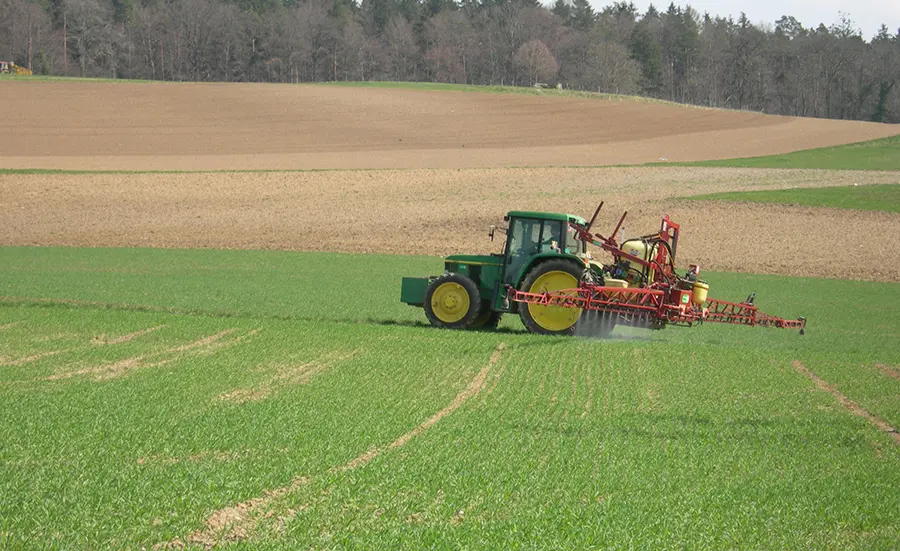
Pesticide residues are widespread in Swiss agricultural soils and often persist there for much longer than assumed in regulatory assessments. It is particularly significant that some residues are still present, even years later, in concentrations that could be of concern to soil organisms.
Soils are a fundamental basis of life, both for food production and for numerous ecosystem services. At the same time, agricultural soils are exposed to a wide range of pressures. These include pesticides, which can remain in the soil after application. Researchers from Agroscope and the Ecotox Centre, in collaboration with other partners, have investigated how widespread such residues are in Swiss agricultural soils and how long they remain detectable beyond the regulatory assumed degradation times. The results show that the reality in the field sometimes differs significantly from the assumptions made in regulatory assessments.
Residues found in all soils analysed
For the study, the researchers sampled a total of 126 agricultural sites spread across Switzerland. These included arable fields, vegetable plots, vineyards and apple and apricot orchards, all of which were farmed conventionally, as well as four organically farmed arable fields as control sites. Samples were taken at each site between November and March to avoid peak contamination levels caused by recent applications during cultivation. The samples were analysed for a total of 146 pesticides, including 127 active substances and 19 transformation products.
Pesticide residues were detected at all 126 sites, even on the organically farmed arable land. However, the number of residues detected there was significantly lower than on the conventionally farmed land. On the conventionally farmed land, depending on land use, residues of between 22 and 28 different pesticides per site were found on average; on one field, the figure was as high as 54. The total of the measured pesticide concentrations was highest on average on vegetable plots.
"These were not exclusively active substances currently in use," explains study leader Thomas Bucheli of Agroscope. "In many cases, transformation products of pesticides that are no longer authorised in Switzerland were also detected. One example of this is atrazine-2-hydroxy, a degradation product of the herbicide atrazine, which has long been banned. This shows that past applications can remain detectable in the soil for a long time.”
It is not just the application that matters
The amount of pesticides found in the soil depended not only on how intensively they had been used, but also on soil properties and climatic conditions. The number of pesticides detected increased with the organic carbon content of the soil and decreased with higher long-term rainfall levels. The study did not directly investigate which processes explain these correlations. Possible explanations include reduced bioavailability, as pesticides are bound to organic soil matter, as well as higher microbial activity and greater migration into the subsoil under wetter conditions. “Dry and humus-rich soils therefore appear to be particularly prone to the presence of pesticide residues,” said Bucheli. “This should be taken into account when selecting sites for soil monitoring.”
Higher persistence than expected
The persistence of pesticides in the soil, measured as the half-life (DT50), is an important criterion in pesticide authorisation. The researchers compared the maximum field DT50 values determined as part of the authorisation process with the persistence observed under real field conditions and found that these values were exceeded in around 60 per cent of cases. The deviation was particularly marked for residues that had already been present in the soil for longer than the corresponding DT90 (the time, determined during the authorisation process, until 90 per cent of the initial quantity has disappeared) at the time of sampling.
This may be because, as the residence time in the soil increases, pesticides become more strongly bound to organic and mineral soil components or are incorporated into soil aggregates. This can slow down their degradation. Regulatory studies, on the other hand, often focus primarily on the early phases of degradation and provide only a limited picture of long-term behaviour.
Potential effects on soil organisms
To assess whether the pesticide residues found could be ecotoxicologically relevant to soil organisms, the researchers compared the concentrations detected with toxicological threshold values specified in the authorisation for various soil animals such as earthworms, springtails and mites. “At 22 of the 126 sites, we found evidence of potential ecotoxicological effects caused by pesticide mixtures,” explains Marion Junghans from the Ecotox Centre. “This was particularly common in apple orchards, but the highest mixture toxicity was found in vegetable fields.” No exceedances were observed for the four organically farmed arable fields or the apricot orchards. Thirteen pesticides contributed to the potential mixture effects, seven of which had lost their authorisation in Switzerland between 2016 and 2021. Three active substances contributed particularly significantly to the potential mixture toxicity: the fungicides difenoconazole and epoxiconazole, and the insecticide chlorpyrifos, which is highly toxic to small soil-dwelling organisms. Of these, only difenoconazole remains authorised.
Residues remain relevant for a long time
Of particular interest are those pesticides that persist in the soil for significantly longer than regulatory data would suggest. For several active substances – including difenoconazole, chlorpyrifos, epoxiconazole, boscalid and fludioxonil – concentrations that are potentially relevant for mixture effects were still measured even after the DT90 period had elapsed. "However, we do not know what proportion of these aged residues is actually still bioavailable," emphasises Marion Junghans. It was not possible to carry out an ecotoxicological assessment for all residues, as chronic data for soil fauna were sometimes unavailable. "Furthermore, we have not taken plants and microorganisms into account here. These may be exposed to additional ecotoxicological risks," adds Junghans.
Swiss soils in a European comparison
The researchers also compared the Swiss results with data from the 2018 European LUCAS soil monitoring programme. This revealed that the potential ecotoxicological pressures on soil fauna in Switzerland were higher across all land-use types considered than in the other European countries studied. The pesticides of particular relevance were largely the same in both datasets, but were detected more frequently or in higher concentrations in Switzerland. The higher levels of contamination could be partly linked to higher application rates or frequencies of certain relevant pesticides in Switzerland.
Implications for authorisation and soil monitoring
The study shows that the persistence data used in the authorisation process do not always adequately reflect the long-term behaviour of pesticides in the field. Long-lived residues, in particular, can remain in the soil well beyond the expected DT90 period. The researchers therefore propose extending persistence studies beyond this timeframe and using models that better reflect the slowing degradation of older residues. For future soil monitoring programmes, they also recommend specifically investigating pesticides that are potentially particularly relevant and harmonising analytical methods more closely.
Finally, risk-based thresholds for pesticides and bioindicators are needed to assess the risk to soil organisms and protect soil fertility: the Ecotox Centre has already developed such thresholds for numerous pesticides and is also optimising the use of bioindicators. "At the same time, further research is needed to assess the actual impacts in the field," says Marion Junghans. "It is particularly important to clarify what proportion of persistent residues remains biologically available." This is the subject of ongoing work by both institutions.
Publication
Rösch, A., Reininger, V., Ranke, J., Perdigón Ferreira, J., Hirte, J., Sutter, P., Wettstein, F.E., Renaud, M., Junghans, M., Viaira, D., Walder, F., Bucheli, T. D. (2026). Longevity of modern pesticides in Swiss agricultural soils: distribution, drivers, and potential environmental implications. Environmental Science: Processes and Impacts, 28(8), 2169-2186. doi.org/10.1039/d5em01048a , Institutional Repository
 E-mail
 Facebook
 Twitter
Contact

 Subscribe to our News by RSS feed