06. October 2026, Topic: Aquatic Ecotoxicology Risk Assessment
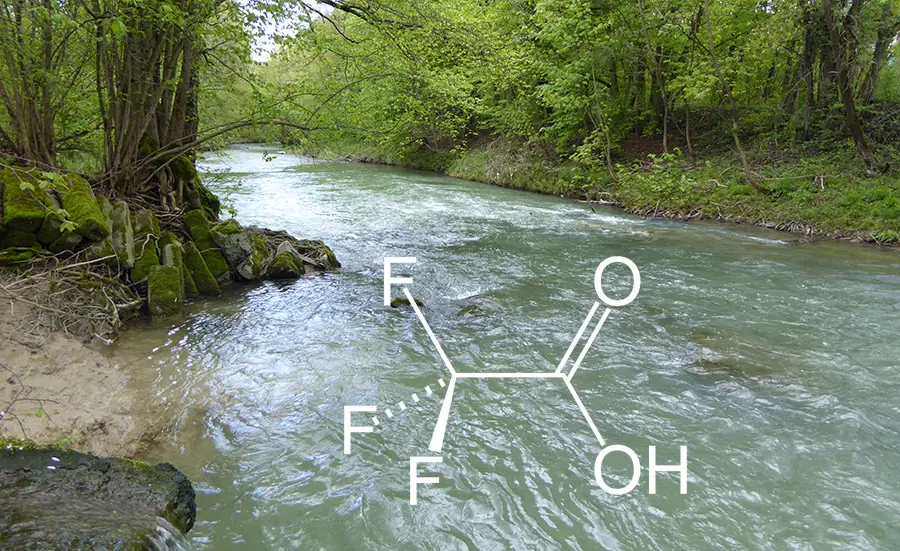
Trifluoroacetic acid: a challenge for water protection and drinking water supply
Trifluoroacetic acid (TFA), an extremely persistent PFAS compound, can be detected in Swiss surface waters and groundwater almost everywhere. Current knowledge about the sources of contamination, potential health effects and the limitations of water treatment leads to a clear conclusion: Anyone wishing to limit contamination in the long term must tackle the problem at the source.
Highly water-soluble, mobile and, according to current scientific understanding, practically non-degradable in the environment: this combination of properties makes trifluoroacetic acid a special case amongst per- and polyfluoroalkyl substances (PFAS). Furthermore, TFA is continuously released into the environment from various sources. This raises a key question for water protection: how can we minimise the further accumulation of this substance, which is already widespread today and is difficult to remove from water?
Sharp increase in watercourses
Recent measurements show just how widespread TFA has become in Switzerland. In a study by the National Groundwater Monitoring Programme (NAQUA), the substance was detected in 2022 and 2023 at 508 out of 517 groundwater monitoring points examined. Around 70 per cent of the concentrations measured were below 1 µg/L and 95 per cent below 2 µg/L, with levels tending to be higher in agricultural regions than in Alpine and pre-Alpine areas.
TFA is also widespread in watercourses. Between 2021 and 2023, measurements at nine monitoring points in five Swiss rivers revealed concentrations ranging from 0.21 to 2.8 µg/L. Within the river systems studied, concentrations tended to increase downstream. Particularly noteworthy, however, is the trend over time: compared with measurements from 1996/1997, the average TFA concentration in the Swiss river network rose from 0.09 to 0.52 µg/L – an increase of approximately sixfold.
Many sources, a particularly persistent substance
TFA enters the environment via various routes. The largest known source in Switzerland is atmospheric deposition. Fluorinated gases from refrigerants are broken down into TFA in the atmosphere and subsequently reach soil and water bodies via precipitation. Because the substance is transported over long distances in this process, it reaches even remote regions in the Alps. For the years 2021 to 2023, researchers have estimated atmospheric deposition in Switzerland at around 24.5 tonnes of TFA per year – more than four times as much as 30 years ago.
Another major source is TFA-forming plant protection products, whose contribution in agricultural areas can be significantly higher than that from atmospheric deposition. Added to this are inputs from industrial and municipal wastewater, from landfill sites and, possibly, from the thermal treatment of waste containing PFAS. Which of these sources dominates depends heavily on the specific location under consideration. Nationwide, atmospheric deposition represents the largest known source of input; however, on individual agricultural plots, plant protection products can make a significantly larger contribution.
Virtually impossible to remove from water
Due to its low molecular weight, high polarity and high water solubility, TFA can only be removed from water at great energy cost. Conventional drinking water and wastewater treatment processes are insufficient for removing the substance, as it does not accumulate in sludge flocs or in the solid phase. Furthermore, activated carbon and anion-exchange resins – which are established methods for long-chain PFAS – are not particularly suitable for TFA.
Technically, TFA can be separated using, for example, nanofiltration or reverse osmosis. Pilot trials show high removal rates – in a drinking water pilot plant, reverse osmosis achieved a removal rate of more than 99.9 per cent. However, this process generates concentrated waste streams, and the energy and cost requirements are high, meaning that these methods are not suitable for wider application.
Processes that actually destroy TFA are currently still at an early stage of development. Whilst initial pilot trials are yielding promising results, such technologies are currently primarily suitable for highly concentrated industrial effluent or waste streams. Widespread removal of TFA from already contaminated environmental waters therefore appears to be neither technically nor economically viable.
And what about the health effects?
In addition to its persistence and widespread occurrence, attention is increasingly turning to its potential health effects. Animal studies have observed, amongst other things, changes to the reproductive system as well as indications of developmental and immunotoxicity. On this basis, the European Chemicals Agency has classified TFA as toxic to reproduction in 2026.
There is very little data available on environmental organisms. TFA appears to be relatively low in acute toxicity for many of the organisms studied; little is known so far about possible chronic effects. According to current knowledge, certain species of algae are particularly sensitive. For numerous other groups of organisms – including soil organisms, terrestrial plants and many marine organisms – reliable data is lacking. This knowledge gap is particularly relevant in the case of a substance with very high persistence: even minor risks can become significant over long periods if a substance is practically non-degradable and is continuously re-introduced.
Better to take early precautions than to have to remediate later
There is currently no specific regulatory limit for TFA in drinking water or surface waters in Switzerland. To protect aquatic ecosystems, the Ecotox Centre has recently derived a chronic quality criterion of 16 µg/L. In the EU, TFA has been included under the Water Framework Directive in the aggregate limit for 25 PFAS, for which a value of 4.4 ng/L PFOA equivalents has been set. This value is based on the EFSA’s assessment of the safe concentration for humans, whose protection is the primary focus here. If a water sample contained only TFA and no other PFAS, the concentration of TFA should not exceed 2.2 μg/L.
Currently, 95 per cent of the levels measured in groundwater are still below this threshold. However, measurement data from the last 15 years show a significant increase in both groundwater and surface waters. And particularly in agricultural areas, groundwater already contains TFA in concentrations of between 1 and 5 µg/L.
Reducing inputs at source
The key conclusion is therefore that prevention is particularly important when it comes to TFA. The existing environmental contamination with this persistent substance can only be reduced at considerable technical and economic cost; preventing new inputs, on the other hand, is far more efficient. This involves, in particular, reviewing the use of substances from which TFA can be formed: refrigerants, certain plant protection products and other precursor substances. In addition, targeted measures for heavily contaminated industrial effluent can help to reduce local releases.
"To ensure that situations such as these, where options for action are severely limited, do not arise in future, a criterion for assessing chemicals should be introduced that is based solely on a substance’s persistence," says Alexandra Kroll from the Ecotox Centre. “This is because, in the case of extremely persistent and mobile substances, subsequent remediation is considerably more difficult than preventing further releases. Reducing such substances at the source at an early stage therefore not only limits environmental impact but also saves, in the long term, the costs of costly treatment and remediation measures.”
Publication
Kroll, A., Rudin, E., Junghans, M., Chow, S., Holmes, B., Scheringer, M., Thalmann, B. (2026) Trifluoressigsäure in der Umwelt. Herausforderungen für Gewässerschutz und Trinkwasserversorgung in der Schweiz. Aqua & Gas 106 (10), 18-25, Institutional repository
 E-mail
 Facebook
 Twitter
Contact

 Subscribe to our News by RSS feed