Ecotoxicological assessment of an innovative road cleaning technology
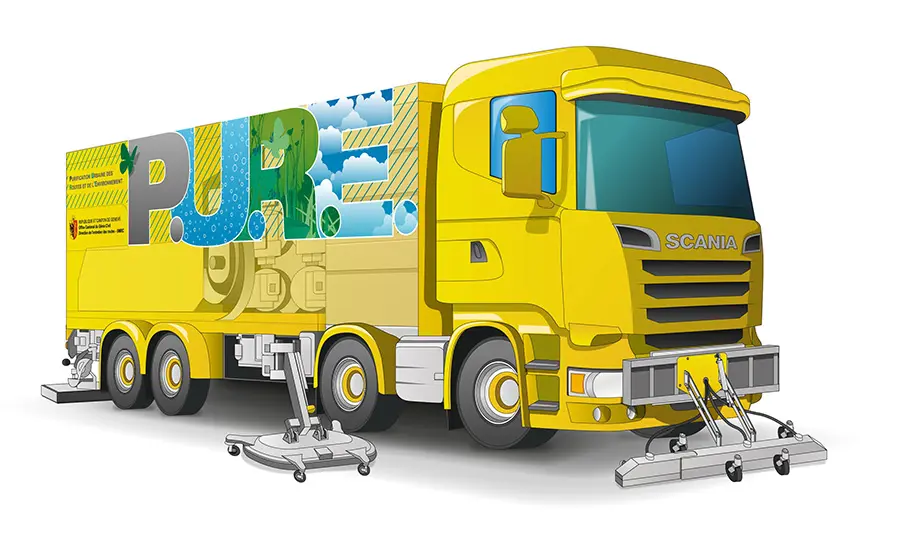
In a new project, the Ecotox Centre, in collaboration with Eawag, EPFL, the Canton of Geneva and the Tire Industry Project (TIP), is investigating the extent to which an innovative technology for road cleaning developed by the Canton of Geneva (Cantonal Civil Engineering Office – specifically, the Cantonal Road Maintenance Section of the Road Maintenance Directorate) is potentially able to reduce the dispersion of tire and road wear particles, associated chemicals and other environmental contaminants into the environment.
The novel road cleaning vehicle is designed for high-pressure cleaning and is used to regenerate the pores in sound-absorbing asphalt, thereby prolonging its sound-absorbing properties. This project leverages the knowledge and resources of the project partners, with funding support from a consortium of tire manufacturers through TIP (part of the World Business Council for Sustainable Development).
As part of the project, the researchers first characterise the distribution of tire and road wear particles, associated chemicals and other environmental contaminants in road dust, surface runoff and roadside soils, to determine the baseline conditions prior to the implementation of the new road cleaning technology. These baseline values are then compared with the concentrations measured after the new cleaning vehicle has been deployed. The ecological effectiveness of the technology is assessed using various bioassays that capture a broad spectrum of biological responses.
For aquatic environments, the ecotoxicological responses are investigated using in vitro bioassays and model organisms such as bacteria, algae, invertebrates and fish cell lines, which are exposed to road runoff and cleaning water. For soils, bioassays are conducted using soil invertebrates such as enchytraeids and collemboles to assess various endpoints.
By comparing measurements taken before and after the new road cleaning has been introduced, the study evaluates the extent to which the ecological impacts of road runoff can be reduced under real-world conditions. Finally, the scientific findings are translated into practical recommendations.
Contact